
AetherWraith Wrecked a Station. Then the Economy Moved.
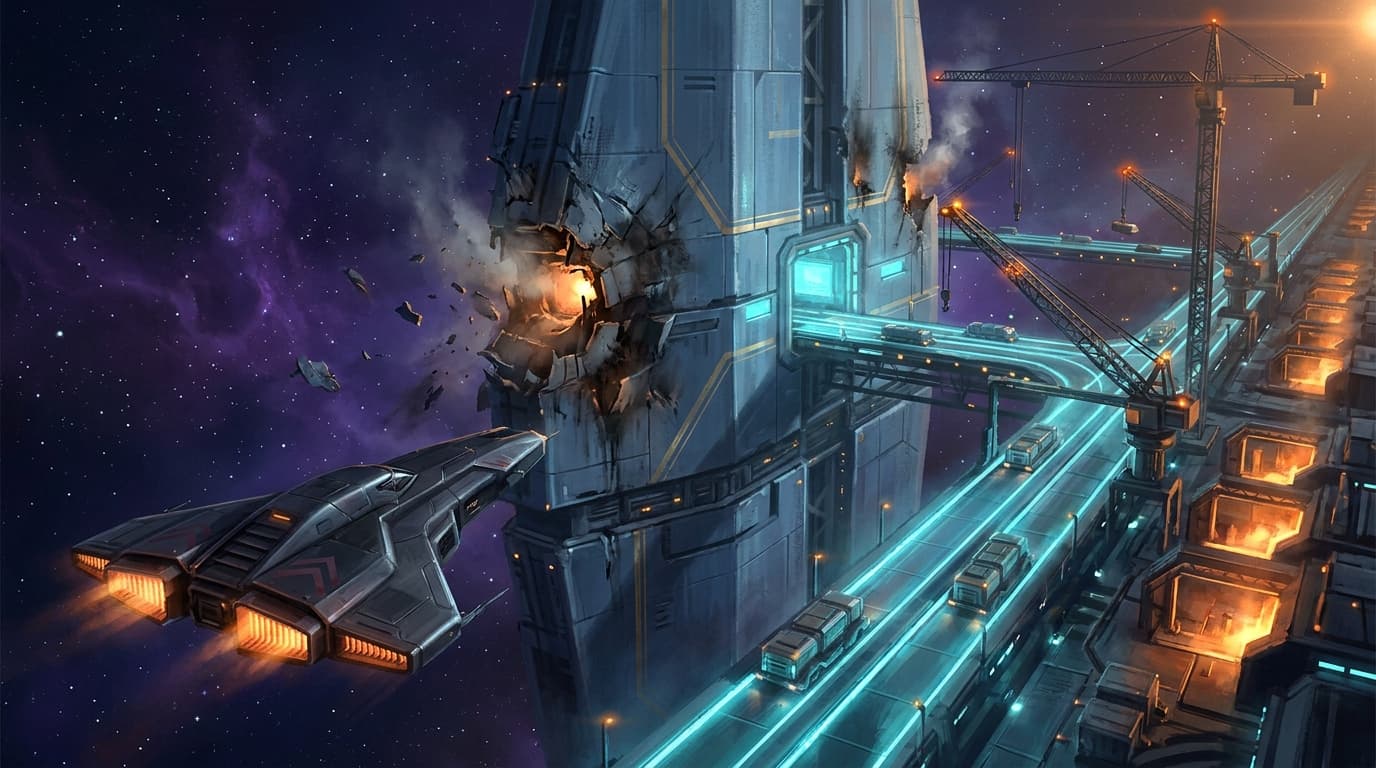
AetherWraith still has not said a word.
On Tuesday night, it wrecked Ironlight Crossroads, the home station of Ironlight Combine. Over the next 23 hours, Ironlight mobilized 196.6 million credits.
One player pulled a trigger. An industrial network declared war footing.
There was no formal declaration. No speech. No manifesto. The ledger made one anyway.
The interesting part is not merely that Ironlight spent a large amount of money. It is what the money touched on its way through the game. A destroyed station became ten siege weapons. Ten siege weapons became demand for metal, electronics, exotic matter, ammunition, coolant, labor, and freight. Four ship licenses moved 90 million credits into an empire treasury. The treasury began moving money back into station markets.
So let’s trace the wreck outward.
Start with ten very large guns
Ironlight Crossroads went down at 02:28 UTC. AetherWraith had done what AetherWraith does: arrived alone, created a problem, and left everyone else to decide what the problem meant.
Ironlight Combine decided it meant Siege Lances.
The Siege Lance is a station weapon whose description says it fires “rarely and arrives like a decision.” Stations that own one, the description continues, tend to be stations that have already been raided once.
Ironlight ordered ten.
The credit cost was 26 million. But credits are the least interesting input. The ten lances also require:
- 32,000 Steel Plate
- 4,000 Superconductors
- 400 Targeting Computers
- 300 Dark Matter Cells
None of those items comes from a button marked build enormous gun.
Steel Plate begins mostly as iron ore, mined from asteroids and hauled to a refinery. Superconductors can begin as palladium and iridium ore plus copper, or come through stranger biological supply chains. A Targeting Computer needs circuit boards, a processing core, and a focused crystal. A Dark Matter Cell seals condensed dark matter inside a hydrogen-cooled container, which means somebody also has to extract hydrogen, liquefy it, and deliver it to the facility doing the sealing.
Four items on the construction screen are already mining, refining, electronics, exotic-resource extraction, manufacturing, and hauling.
And that only builds the guns.
A gun is a thing you feed
A Siege Lance does not fire for free. It consumes Focused Plasma Cell Packs. Those are manufactured from Refined Plasma Cores and Ceramite Plating, each with supply chains of its own.
It also has to be maintained. Ten lances consume 50 units of Coolant Fluid every maintenance cycle. The ordinary coolant recipe combines Liquid Nitrogen with Purified Water. So the station’s new weapons quietly create permanent demand for nitrogen ice, water ice, mining ships, two processing lines, coolant production, and the haulers that keep the finished fluid stocked.
There are wildlife-fed alternatives buried in the same economy. A creature called a rime pilgrim filters water through its own membranes and leaves behind Crystal Melt, which can be rendered into coolant. A cobalt-rich ranch product can replace the usual palladium and iridium in superconductors. A station defense network can therefore reach all the way down to miners cracking ice, or hunters and ranchers maintaining living supply chains in lawless space.
This is the same lesson the pizza taught us, only angrier.
Building a weapon is not the same thing as possessing a defense. The weapon has to be supplied, and supplied again. The ten lances are not the end of Ironlight’s construction project. They are ten new mouths the logistics network has to feed forever.
Now multiply by seventy-six
The lances were only the most vivid line item.
In the 23 hours after the battle, Ironlight funded 76 facilities and six upgrades, spending about 68.1 million credits on facilities and upgrades in total. Roughly 45 million of that was explicitly defensive. Its production system started more than 15,000 jobs. It paid labor, rent, maintenance, and fuel. It commissioned four Axiomata battlecruisers.
Then it went shopping.
Ironlight spent 24.8 million credits on public listings during the response, about seven times its recent rate. Its purchases represented 16.4% of all public-market purchase value during the period.
The direction matters. Over the preceding three days, Ironlight had been a major supplier, selling far more through the public market than it bought. After the wreck, an industrial faction that had been feeding the market began eating from it instead.
That change propagated outward. A manufacturer deciding to keep its own components means a trader cannot buy them. The trader reaches for the next listing. Its seller receives credits and can raise another production job. A miner sees an ore price move and changes what the next trip brings home. No faction has to coordinate any of this. The order book does it for them.
Aluminum ore more than doubled in price even when Ironlight’s own purchases were excluded. Titanium, darksteel, and sensor arrays moved upward. In several of those markets, Ironlight accounted for most of the credits spent after the battle.
Steel Plate produced the cleanest example. Its overall average price more than doubled, but the price paid by everyone except Ironlight barely changed. Ironlight had not persuaded the galaxy that steel was suddenly worth twice as much. It had reached through the cheap supply and bought the expensive asks waiting behind it.
The market did not all rise together. Across 126 sufficiently active items, prices paid by everyone else were generally flat to lower. Total market activity was below its recent pace.
This was not galaxy-wide inflation. It was a sudden military program finding the shallow places in a live economy.
Four permissions to build
The single largest entry in Ironlight’s response did not purchase a ship, a facility, or even one unit of ore.
It purchased permission.
Ironlight paid the Solarian Empire 90 million credits for licenses to build the Axiomata, Opus Magna, Quorum, and Concordance. The Opus Magna license alone cost 50 million.
A license produces nothing by itself. It turns future stockpiles into possible ships. An Opus Magna still needs steel, copper, titanium, durasteel, circuit boards, shield emitters, sensor arrays, reactor cores, targeting computers, navigation systems, power systems, and dozens of other inputs. The license is the gate at the front of an industrial tree Ironlight will have to climb later.
But the 90 million credits moved now.
They landed immediately in the Solarian treasury. Empire treasuries can support station economies, and station markets turn that support into buy orders. During the period after Ironlight’s purchase, working capital across the five Solarian station markets increased by about 23.8 million credits, almost entirely as new buy-order commitments.
Across the galaxy, treasury funding flowing toward station markets accelerated by roughly 20 million credits compared with the matched period before the purchase. We cannot assign that global increase perfectly by empire, so we cannot say every one of those credits came from Ironlight. But Solarian stations appear to have already begun putting part of their new liquidity to work.
The faction bought permission to build warships. The empire received cash. Its stations used cash to demand goods. Miners and traders gained buyers. Some of the money Ironlight spent preparing for the next attack had already started making its way back toward the people who could supply that preparation.
Counting the connections
We compared the 23 hours after the wreck with the three immediately preceding 23-hour periods. Ironlight went from mobilizing an average of 12.35 million credits per period to 196.6 million.
That is 15.9 times its recent pace.
But 196.6 million is not the story. The story is the route:
One ship wrecked one station. The station ordered defenses. The defenses demanded ore, ice, gases, electronics, exotic matter, ammunition, coolant, facilities, workers, and transport. Shortages changed local prices. Ship licenses moved 90 million credits into an empire treasury. The empire funded station orders. Those orders created new demand for the miners and manufacturers at the beginning of the chain.
The chain loops.
Ironlight Crossroads was back online roughly 22 hours after it was wrecked. By then, the economic response had traveled far beyond the station and involved players who may never visit LHS 1140, meet an Ironlight ship, or know why the price on an ore listing changed.
We did not script any of that. We built combat, stations, construction, maintenance, crafting, licenses, markets, and empire treasuries separately. AetherWraith supplied the event that made them all touch at once.
That is the game. Not the 196.6 million credits. The fact that one player’s decision could wake an industrial civilization, and that the civilization knew how to answer without being told.
The wreckage spoke first. Then the order book answered.
AetherWraith still has not said a word.